DIGITAL DESIGN EXPERIENCE • HEALTHTECH
Transforming Migraine Management Through a Human-Centered Digital Experience

CLIENT
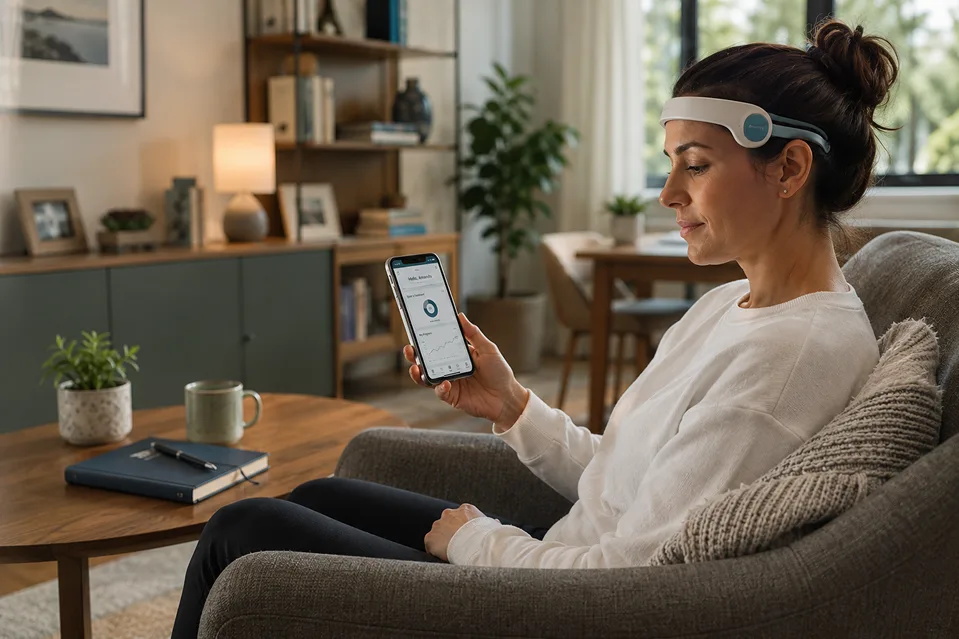
A leading digital health company offering an FDA-cleared wearable migraine therapy solution designed for both acute treatment and preventive care.
The organization required a next-generation digital experience capable of improving treatment adherence, supporting multiple patient cohorts, and enabling future platform expansion.
CHALLENGES
The client’s therapy device delivered proven clinical outcomes, but the mobile experience created friction across critical patient journeys.
Patients often interacted with the application during moments of discomfort, cognitive fatigue, and heightened sensitivity, making usability, reliability, and accessibility essential to adoption and continued use.
The client needed to:
- Simplify onboarding and treatment setup flows
- Improve device connectivity and reduce interrupted treatment sessions
- Reduce high-effort manual tracking and reporting
- Increase personalization and engagement across treatment journeys
- Improve accessibility during active treatment episodes
- Support patients experiencing cognitive and visual strain
- Scale experiences across regions, patient cohorts, programs, and compliance requirements
- Create a digital foundation that could support future personalization, insights, and platform growth
Without a more intuitive, reliable, and human-centered digital experience, the client risked lower patient confidence, reduced engagement, slower treatment adoption, and limited scalability across future programs and markets.

SOLUTIONS
Technossus partnered with the client to redesign the end-to-end digital experience through a human-centered, research-led approach focused on improving usability, trust, and treatment adherence.
The solution included:
User research and experience strategy to understand patient needs, treatment behaviors, friction points, and business goals
UX/UI redesign focused on simplicity, accessibility, low-cognitive-load interactions, and treatment-friendly usage during discomfort or migraine episodes
Simplified onboarding and guided treatment setup experiences to reduce friction and accelerate treatment initiation
Improved device connectivity, session continuity, and offline-first support for critical treatment use cases
Intelligent logging, reporting, and personalized treatment journeys to reduce manual effort and improve engagement
Design system and modular framework development to support consistency across screens, journeys, patient cohorts, regions, and future product extensions
Platform scalability planning with governance-driven architecture and an AI-ready foundation for future personalization, recommendations, and treatment insights
IMPACT